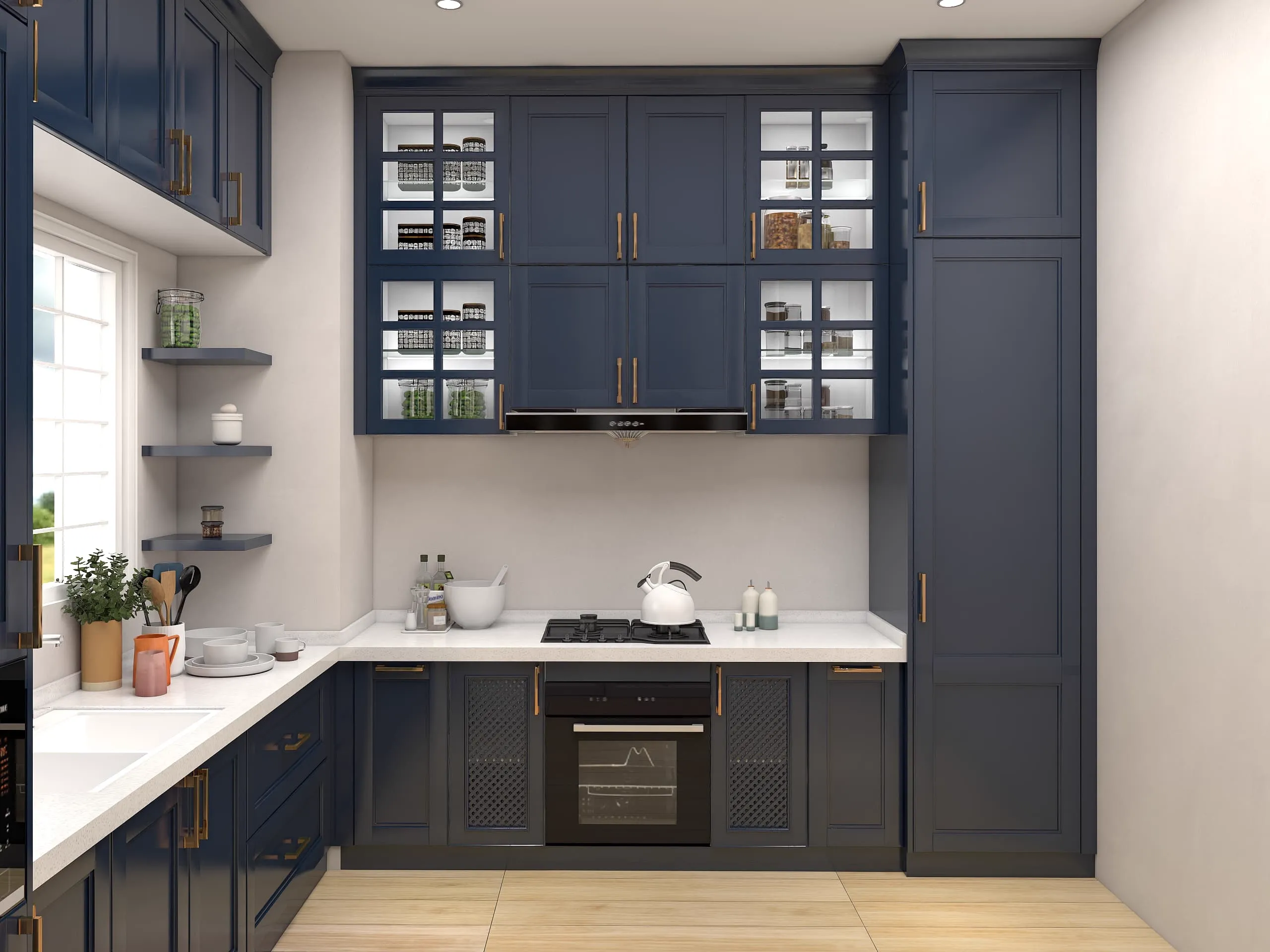
Kitchen Cabinets from China: A UK Specification and Enquiry Guide
What to confirm before ordering kitchen cabinets from China for a UK project: real costs, specifications, quality checks and a simple enquiry pack.
Read the guideSliding vs hinged wardrobe doors compared on UK prices, BS EN durability standards, door weight, space maths and repair costs.

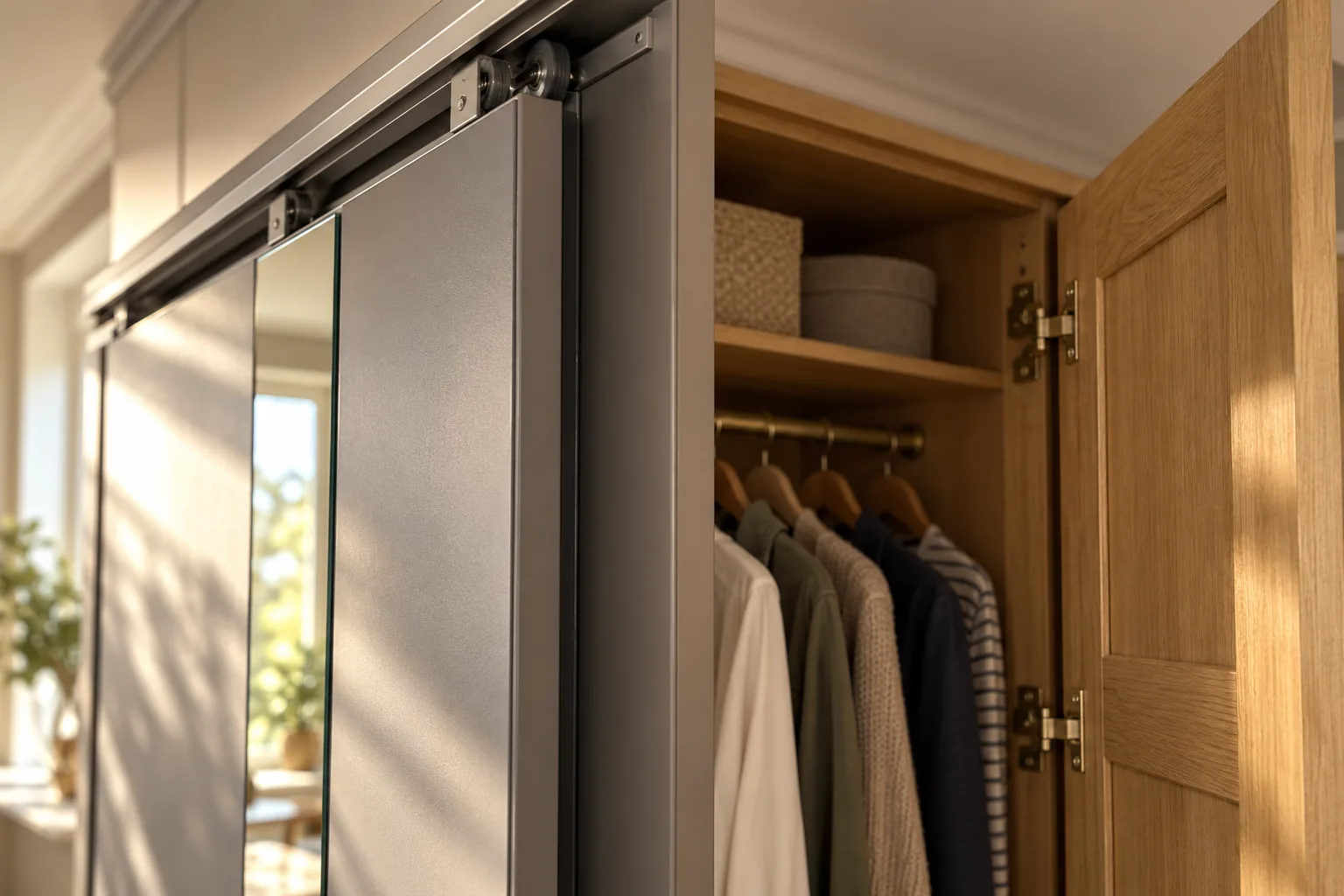
Checkatrade 2024: 3-door hinged averages £3,250 vs sliding £3,700 — the premium buys the track system, rollers and larger door leaves.
BS EN 15706 rates sliding fittings at 10,000/20,000/40,000 cycles; hinges run 80,000–200,000. Get the hardware brand and grade in writing.
Hinged needs swing clearance equal to door width; sliding needs zero — but costs 80–100mm of depth and only ever opens half the wardrobe.
The short answer: sliding doors cost more, save floor space, and live or die by the quality of their track hardware; hinged doors are cheaper, give full access, and need room to swing. Checkatrade's 2024 figures put the sliding premium at roughly £450 on an average 3-door fitted wardrobe (£3,700 vs £3,250). Whether that premium is money well spent comes down to three numbers almost no comparison guide gives you: the durability grade of the track system (BS EN 15706 rates them at 10,000 / 20,000 / 40,000 cycles), the weight of your door leaves (a 4mm mirrored door carries ~20kg of glass), and the swing clearance your bedroom can actually spare. This guide puts those numbers on the table.
Sliding vs hinged at a glance, October 2026. Sources for every figure are in the sections below and the Methodology.
| Hinged doors | Sliding doors | |
|---|---|---|
| Fitted price, 3-door (Checkatrade 2024) | £2,500–£4,000 (avg £3,250) | £2,800–£4,600 (avg £3,700) |
| Hardware standard | BS EN 15570 (hinges) | BS EN 15706 (sliding fittings) |
| Hardware durability benchmark | 80,000–200,000 cycles (Häfele FIRA Level H / Blum) | 10,000–40,000 cycles (Hettich EN 15706 levels) |
| Floor space needed in front | Door width as swing clearance (600mm door → 600mm) | None |
| Wardrobe access | 100% of interior at once | ~50% at any one time |
| Internal depth cost | None | ~80–100mm for tracks and overlap |
| Max practical door width | ~750mm (hinge load + swing) | ~1,200mm per panel |
| Typical failure | Hinge sag, loose screws | Worn rollers, track jump, misalignment |
| Style constraints | Any style incl. true framed shaker | No true framed fronts; best for mirror/glass |
Already pricing a wardrobe and weighing up door types? Send us your room dimensions — we'll quote both options line by line so you can compare on real numbers, within 24 hours. Send your measurements →
Most "sliding vs hinged" articles talk about taste. The more useful starting point is that the two door types are governed by two different hardware durability standards — and the numbers inside them are not equal.
Hinges fall under BS EN 15570 (strength and durability of hinges pivoting on a vertical axis). Sliding-door gear has its own dedicated standard, BS EN 15706:2009 — "Hardware for furniture: strength and durability of slide fittings for sliding doors and roll fronts" — which exists precisely because sliding systems fail differently: rollers wear, tracks deform, doors jump. Both sit alongside BS EN 14749, the overall safety standard for domestic storage units that every fitted wardrobe should meet regardless of door type.
What the manufacturers certify against those standards:
Hardware durability benchmarks from official manufacturer documentation, October 2026. Cycles = one open-close operation.
| Hardware | Standard / scheme | Certified durability | What that means at 5 uses/day |
|---|---|---|---|
| Hettich SlideLine (sliding), Level 1 | DIN EN 15706 | 10,000 cycles | ~5 years |
| Hettich SlideLine (sliding), Level 2 | DIN EN 15706 | 20,000 cycles | ~11 years |
| Hettich SlideLine (sliding), Level 3 | DIN EN 15706 | 40,000 cycles | ~22 years |
| Häfele Metalla hinge (hinged) | FIRA Level H | 80,000 cycles | ~44 years |
| Blum hinge (hinged) | Blum internal test | 200,000 cycles | Effectively lifetime |
Two deductions follow. First, hinged hardware outlasts sliding hardware by a wide margin at the top end — a Blum hinge is tested to five times the cycles of the best Hettich sliding grade. Second, the sliding range is enormous: a Level 3 system lasts four times as long as Level 1, and the quote rarely tells you which one you are getting. When a sliding wardrobe is quoted suspiciously cheap, the track grade is usually where the money was saved. Ask for the track brand and its EN 15706 level in writing — it's the single most important line in a sliding-door quote, and any serious supplier (including us — send your measurements for an itemised quote with named hardware) will answer it.
The UK market's most useful data point here is Checkatrade's 2024 cost guide, because it is one of the very few sources that splits fitted wardrobe pricing by door type:
UK wardrobe prices by door type, October 2026. Checkatrade figures are supply-and-fit via its member trades; MyBuilder and Spaceslide are shown as anchors — note Spaceslide is a kit-plus-installation model, not full bespoke.
| Source | Hinged | Sliding | Notes |
|---|---|---|---|
| Checkatrade (2024), 3-door fitted | £2,500–£4,000 (avg £3,250) | £2,800–£4,600 (avg £3,700) | Like-for-like comparison; sliding premium ≈ £450 |
| MyBuilder (2025), sliding fitted | — | £2,000–£4,500 | Broad range; blends kit and bespoke |
| Spaceslide (kit + install) | — | From £984 + £349/wardrobe installation | Promotional pricing at time of check; DIY-adjacent route |
| Factory-direct custom (our route) | Quoted per project | Quoted per project | Same carcase; the difference is door leaves + hardware, itemised |
Read the Checkatrade line carefully: the ~£450 average premium is not "sliding doors cost more" as a law of nature — it is the market price of the track system, the rollers, and the larger engineered door leaves sliding requires. A sliding door leaf is typically wider (up to ~1,200mm per panel versus ~750mm for a hinged door), must stay perfectly flat to run true, and in mirrored form carries real weight. Which brings us to the number that decides whether a sliding system lasts.
Sliding tracks have load limits — mainstream residential systems are typically rated in the 30–45kg per door band depending on the range. Hinges have their own limits, which is why hinged doors top out around 750mm wide. The material you hang on the door decides how close to those limits you run.
Glass weighs 2.5kg per m² per mm of thickness (Pilkington's official figure). The arithmetic for a typical mirrored sliding door:
Door leaf weight estimates, October 2026. Glass at 2.5kg/m²/mm (Pilkington); 18mm MFC at ~12kg/m² typical; frames and hardware add further weight. Estimates, not specifications.
| Door leaf (900 × 2,200mm ≈ 2m²) | Material | Approx. weight | Hardware strain |
|---|---|---|---|
| Hinged, painted MFC shaker | 18mm MFC, framed | ~24kg (shared across 3–4 hinges) | Low — well within hinge ratings |
| Sliding, MFC panel | 18mm MFC | ~24kg | Low — mid-range of track rating |
| Sliding, 4mm mirrored | 4mm mirror glass (10kg/m²) | ~20kg glass + frame | Moderate — check track rating |
| Sliding, 6mm mirrored or lacquered glass | 6mm glass (15kg/m²) | ~30kg glass + frame | High — standard tracks at their limit |
The practical rule: mirror and glass sliding doors are where cheap track systems fail first. A Level 1 (10,000-cycle) track carrying 30kg of glass per door is a repair appointment waiting to be booked. This is also why "can I have mirrored sliding doors?" and "how long will they last?" are the same question asked two ways — and why we quote mirror-door projects on mid- or top-grade tracks only.
This is where sliding doors win their premium back — or don't. The physics are simple: a hinged door sweeps an arc equal to its width, and UK manufacturers' technical guidance is blunt about it: keep the floor clear in front of a 600mm door to a depth of 600mm, and treat ~750mm as the practical maximum hinged door width (hinge load plus swing space). No British Standard mandates this — it is industry practice, but it is physics either way.
Now place that arc in the rooms Britain actually has:
Door-type fit by bedroom scenario, October 2026. Dimensions are typical for the UK housing stock described; measure your own room before deciding.
| Bedroom scenario | Hinged works? | Sliding works? | Why |
|---|---|---|---|
| Box room, bed 700mm from wardrobe front | Tight — door hits bed or you sidle around it | Yes, comfortably | 600mm door needs 600mm clear swing; sliding needs zero |
| Standard semi double, 1.2m+ clear in front | Yes | Yes | Either works; decide on access vs hardware life |
| Wardrobe across chimney breast alcoves | Yes | Usually no | Tracks need a continuous straight run; alcove breaks it |
| Full wall of wardrobes, 4m+ run | Yes, but many doors | Yes, 3–4 wide panels | Sliding shines on wide runs; hinged means 6+ doors |
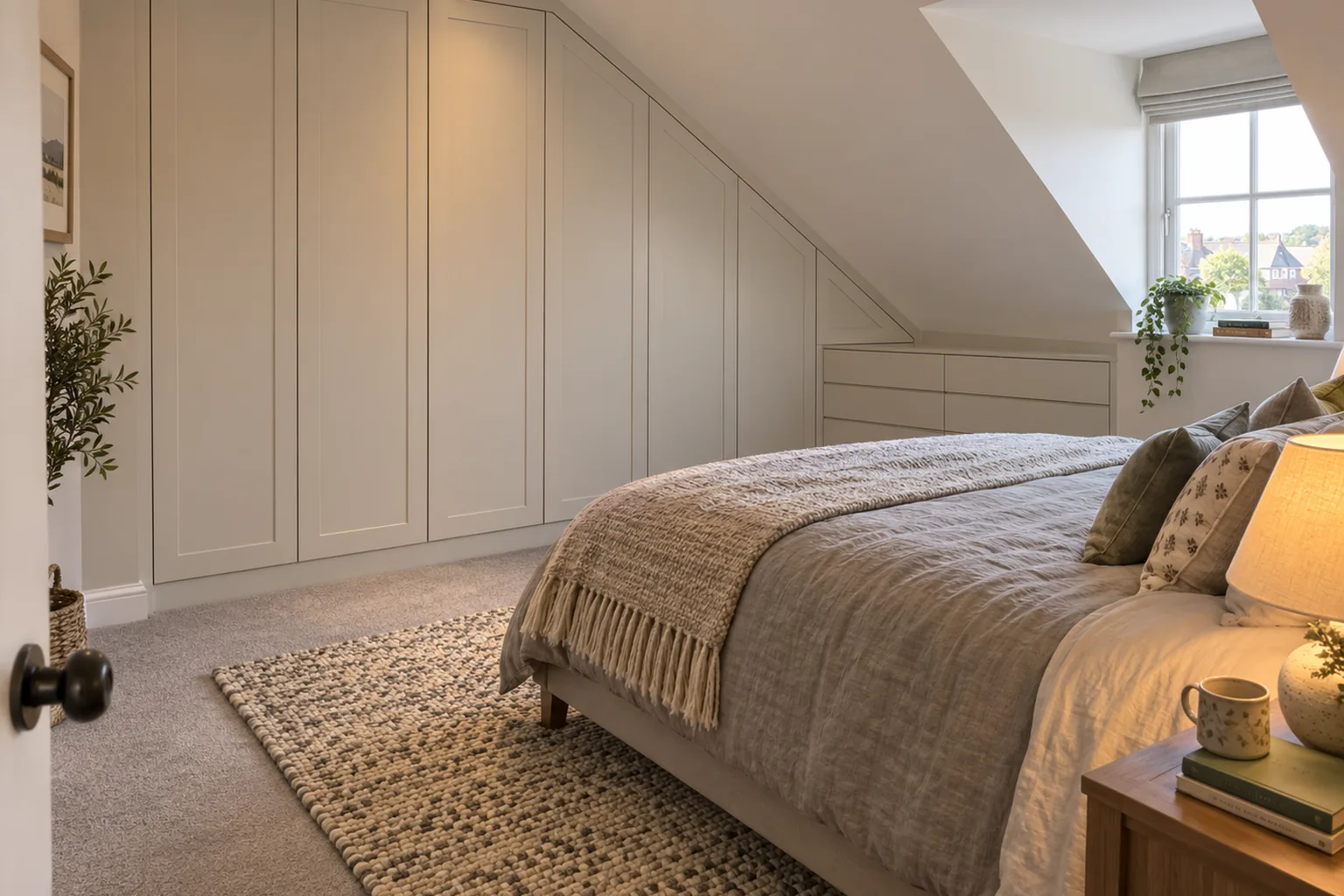
| Sloped-ceiling loft room | Yes — cut to rake | Difficult | Tracks need a level head line; hinged leaves scribe to slope |
Two trade-offs travel with sliding's zero-swing advantage. You lose 80–100mm of internal depth to the track and door overlap — on a 600mm-deep wardrobe that is a sixth of your hanging depth gone. And you can only ever open half the wardrobe at once; on a two-door slider, one side is always closed. Hinged gives 100% access and full depth, and its failure mode (a sagging hinge, a £5 screw fix) is kinder than sliding's (rollers, alignment, track cleaning) — but none of that matters if the door physically cannot open past your bed. If your room sits between the rows above, this is exactly the judgement call our design process is built for: we model your room in 2D and 3D and test both door types against your actual clearances before anything is priced.
Ownership cost is purchase price plus repairs. The failure modes differ enough to plan around:
Typical failure and repair profile, October 2026. Costs are indicative UK parts-and-labour ranges from trade-platform guidance.
| Hinged | Sliding | |
|---|---|---|
| Most common failure | Hinge sag; screws pulling from MFC | Worn/broken rollers; door jumping track |
| Second failure | Soft-close mechanism wear | Track debris; guide misalignment |
| DIY repair cost | £5–£20 (screws, hinge plates) | £10–£30 (roller kits) |
| Pro repair call-out | £60–£120 | £80–£150 (re-alignment is fiddlier) |
| Part availability in 10 years | Excellent — hinge standards are universal | Depends on brand — name-brand track systems keep spares; unbranded tracks often don't |
| Full failure scenario | Door sags, still usable | Door off track, wardrobe unusable until fixed |
The part-availability row deserves emphasis. A Häfele or Blum hinge bought today will have compatible replacements in 2036 almost anywhere in the UK or Ireland. An unbranded sliding track from a no-name kit may have no spares chain at all — which circles back to the first section: the hardware brand and grade is the whole ballgame for sliding, and a minor detail for hinged.
Some choices are made for you by construction physics:
Style vs door type, October 2026.
| Look you want | Hinged | Sliding |
|---|---|---|
| True framed shaker (5-piece frame-and-panel) | Yes | No — frame profile clashes with overlapping tracks; weight strains rollers |
| Shaker-effect (routed/applied moulding panel) | Yes | Partial — yes, with caveats on moulding depth |
| Full-width mirror doors | Partial — possible, but heavy per leaf | Yes — the natural home of mirror |
| Handleless push-to-open | Yes | Partial — sliding needs grips or recessed pulls |
| Curved/corner runs | No | Partial — specialist curved track systems only |
| Floor-to-ceiling 2.7m+ single leaves | Partial — needs extra hinges, deflection risk | Yes — tall panels are sliding's strength |
The shaker row surprises people: genuine framed shaker fronts are hinged-only territory. If the brief is a period-appropriate shaker bedroom (half the Victorian and Edwardian terraces in England), that alone settles the question — see how this plays out in alcove scenarios in our fitted wardrobe cost guide. Conversely, if the brief is a wall of mirrors in a tight box room, sliding is the only sensible answer.
From a manufacturer's bench, the two door types share everything except the front. The carcase — 18mm board, same cutting list, same edge-banding, same internals — is identical. Your money goes to three places:
Because the carcase is the same, a factory-direct quote can show you both door options on the same wardrobe, line by line — carcase, leaves, hardware, fitting — which is a comparison no UK showroom routinely offers. If you're at the stage of choosing a supplier rather than a door type, our 10 checks for choosing a fitted wardrobe company covers the rest of the questions to ask. For an overview of who we are and how factory-direct supply works for UK and Irish homes, start from the George Group homepage.
Want both options priced on your actual rooms? Send your dimensions and we return an itemised quotation — same carcase, both door systems, hardware named and graded — free, typically within 24 hours.
George Group is a factory-direct custom furniture manufacturer supplying fitted wardrobes — hinged, sliding, or a mix of both across a project — to the UK and Ireland. Every wardrobe is built to your rooms: we work from your measurements or drawings, design each unit in 2D and 3D, manufacture in our own factory, and manage the chain to your door, with installation through UK fitting partners. The same supply chain serves Ireland, with Irish VAT handled at booking.
For the door-type decision specifically, what you get from us:
How a George Group quotation works, October 2026.
| What you send | What we review | What your quotation shows |
|---|---|---|
| Room measurements or floor plan | Dimensions, ceiling heights, clearances | Itemised carcase pricing |
| Photos of the rooms | Swing clearance, bed position, alcoves, slopes | Door-type recommendation with reasons |
| Style references (links, photos) | Shaker vs slab vs mirror brief | Door leaf & finish line items, both door types |
| Mirror/glass preferences | Weight, tint, panel layout | Hardware grade matched to door weight |
| Your location (UK or Ireland) | Freight route, clearance, VAT treatment | Logistics, delivery, installation & VAT breakdown |
Quotations are free, itemised, and typically returned within 24 hours —
The honest limits of both door types — and of buying them from us:
None of these change the core maths: the sliding premium is ~£450 at UK retail for hardware that varies fourfold in certified durability — so whoever you buy from, get the track brand and EN 15706 level, or the hinge brand, in writing.
Data collected 29 September – 1 October 2026. Price data: Checkatrade fitted wardrobes cost guide (2024 — 3-door standard £2,500–£4,000 avg £3,250; 3-door sliding £2,800–£4,600 avg £3,700); MyBuilder fitted wardrobes price guide (2025 — sliding £2,000–£4,500); Spaceslide sliding wardrobe doors and installation pages (retail kit pricing at time of check, from £984.14 + installation from £349 — promotional prices fluctuate). Hardware durability: Hettich SlideLine system catalogue (DIN EN 15706 durability levels 1/2/3 = 10,000/20,000/40,000 cycles); Häfele UK — Metalla hinges (tested to FIRA Level H, 80,000 cycles); Blum product quality (hinge testing 200,000 cycles — note Blum's own figure, not the FIRA level). Standards: BS EN 15706:2009 (sliding-door fittings) and BS EN 15570:2008 (hinges); BS EN 14749:2016+A1:2022 (domestic storage unit safety). Door weight: Pilkington Glassary (glass weighs 2.5kg/m² per mm of thickness). Swing clearance and the ~750mm hinged-door width limit are industry practice per UK made-to-measure manufacturers' technical guidance — no British Standard mandates clearance figures, and none is claimed. Weight estimates in the door-weight table are engineering estimates from material densities, not manufacturer specifications. Repair cost ranges are indicative, from UK trade-platform guidance; actual costs vary by region. Years-at-5-cycles-per-day figures are illustrative arithmetic, not a lifespan guarantee.
Choosing door types for a project right now? Send your room dimensions — we'll quote hinged and sliding side by side on the same carcase, with hardware brands and durability grades named, free and typically within 24 hours.
Yes, on like-for-like fitting. Checkatrade's 2024 cost guide puts a standard 3-door hinged fitted wardrobe at £2,500–£4,000 (average £3,250) against £2,800–£4,600 (average £3,700) for the same wardrobe with sliding doors — a premium of roughly £450, which buys the track system, rollers and larger engineered door leaves. At the DIY end the gap narrows: kit sliding door sets start from around £984 (Spaceslide Classic) plus installation.
It depends on the track hardware grade. Under BS EN 15706 (the dedicated standard for sliding-door fittings), Hettich rates its SlideLine systems at three durability levels: 10,000, 20,000 and 40,000 open-close cycles. At five cycles a day, that is roughly 5, 11 and 22 years of daily use. A quote that doesn't name the track brand and grade is quoting the bottom level by default.
They can — jumping the track is the most common sliding-door failure, usually caused by worn bottom rollers, debris in the track, or a door that was never aligned correctly. It is repairable: replacement roller kits cost £10–£30 and most systems lift out for adjustment. Quality systems with anti-jump features and top-hung designs reduce the risk significantly.
Sliding, in most cases. A hinged door needs clear floor space in front of it equal to the door width — a 600mm door needs 600mm of swing room, and in a typical UK box room that arc is exactly where the bed stands. Sliding doors need zero clearance in front, though they cost you roughly 80–100mm of internal depth for the track and leave half the wardrobe closed at any time.
Not a true framed shaker. A shaker door is a five-piece frame-and-panel construction designed to hang on hinges; on a sliding system the frame profile interferes with the overlapping tracks and the added weight strains the rollers. Some suppliers offer shaker-effect sliding doors (a routed or applied-moulding panel), but if you want a genuine framed shaker front, hinged is the only route.
Mainstream residential systems are typically rated around 30–45kg per door depending on the range — check the manufacturer's specification. Weight matters with mirrors: glass weighs 2.5kg per m² per mm of thickness (Pilkington), so a 4mm mirrored door at 900 × 2,200mm carries about 20kg of glass alone, before the frame. Wide triple-mirror designs can push standard tracks to their limit.
Full-width 1980s mirror walls, yes — but mirrored sliding doors remain one of the most practical choices for small UK bedrooms: they bounce daylight and visually double a tight room. The current preference is for framed mirror panels, bronze or grey tints, or a single mirrored door mixed with panelled doors, rather than wall-to-wall silver.
Usually no, not as a simple swap. Sliding systems need a top track and a bottom track (or top-hung rail) plus 80–100mm of depth for two overlapping doors — depth a hinged carcase doesn't have. It is normally more cost-effective to replace the whole frontage or the wardrobe itself than to retrofit sliding gear onto a carcase designed for hinges.
What to confirm before ordering kitchen cabinets from China for a UK project: real costs, specifications, quality checks and a simple enquiry pack.
Read the guideSloping ceiling wardrobes cost £1,500–£5,999 fitted in the UK. Compare ready-made, specialist and import prices for loft and eaves runs, with worked examples.
Read the guideUnder stairs storage costs £250–£8,000 in the UK. Compare specialist, joiner and import prices, worked examples, regulations and when importing pays.
Read the guideSend your drawings or a short brief — a dedicated coordinator replies with next steps and a consolidated quote.