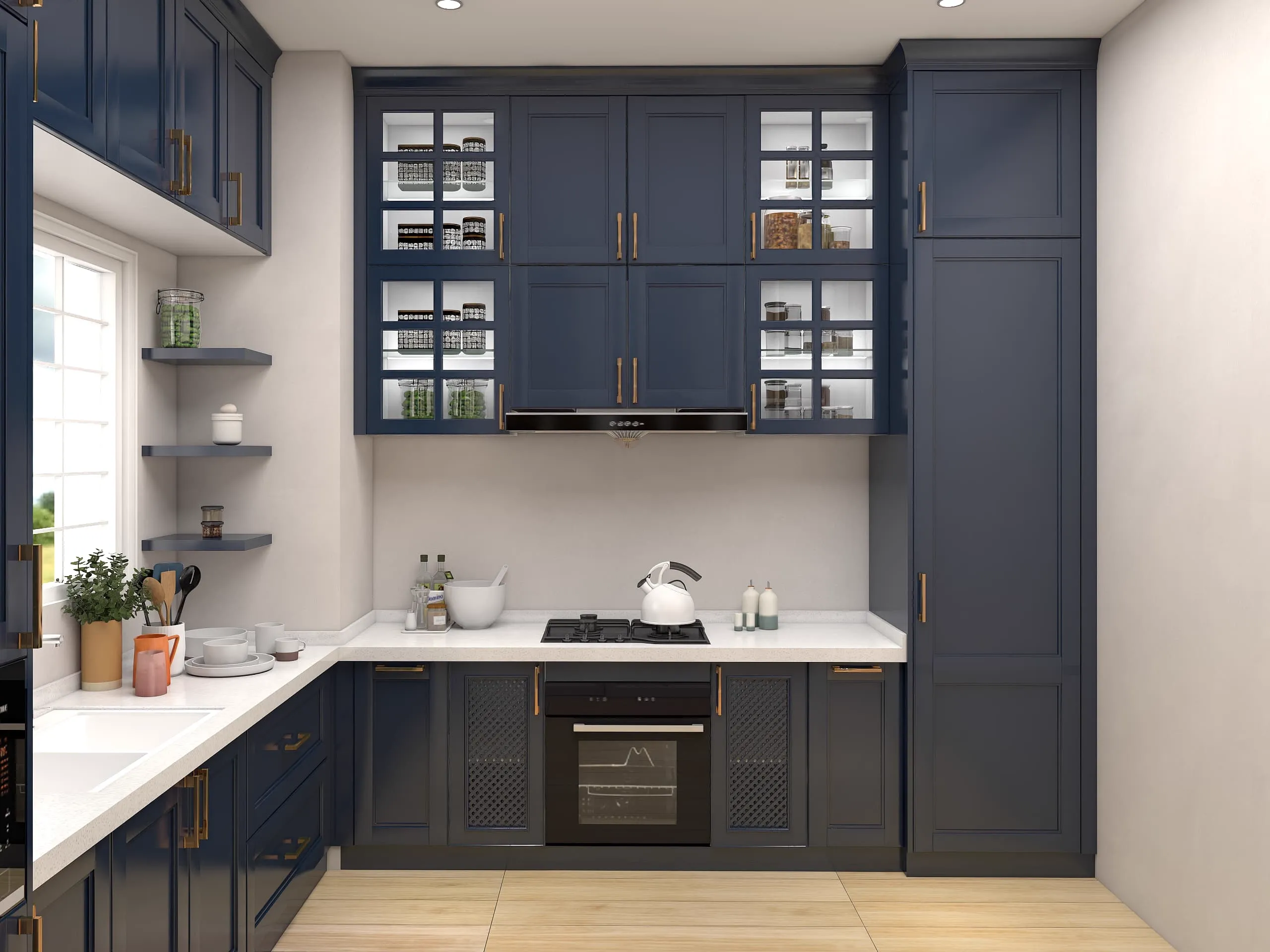
Kitchen Cabinets from China: A UK Specification and Enquiry Guide
What to confirm before ordering kitchen cabinets from China for a UK project: real costs, specifications, quality checks and a simple enquiry pack.
Read the guideUK fitted home office costs: £900–£3,000 for a desk wall, £3,500–£10,000+ bespoke. A 2.4m study wall priced line by line, plus the 2026/27 tax rules.

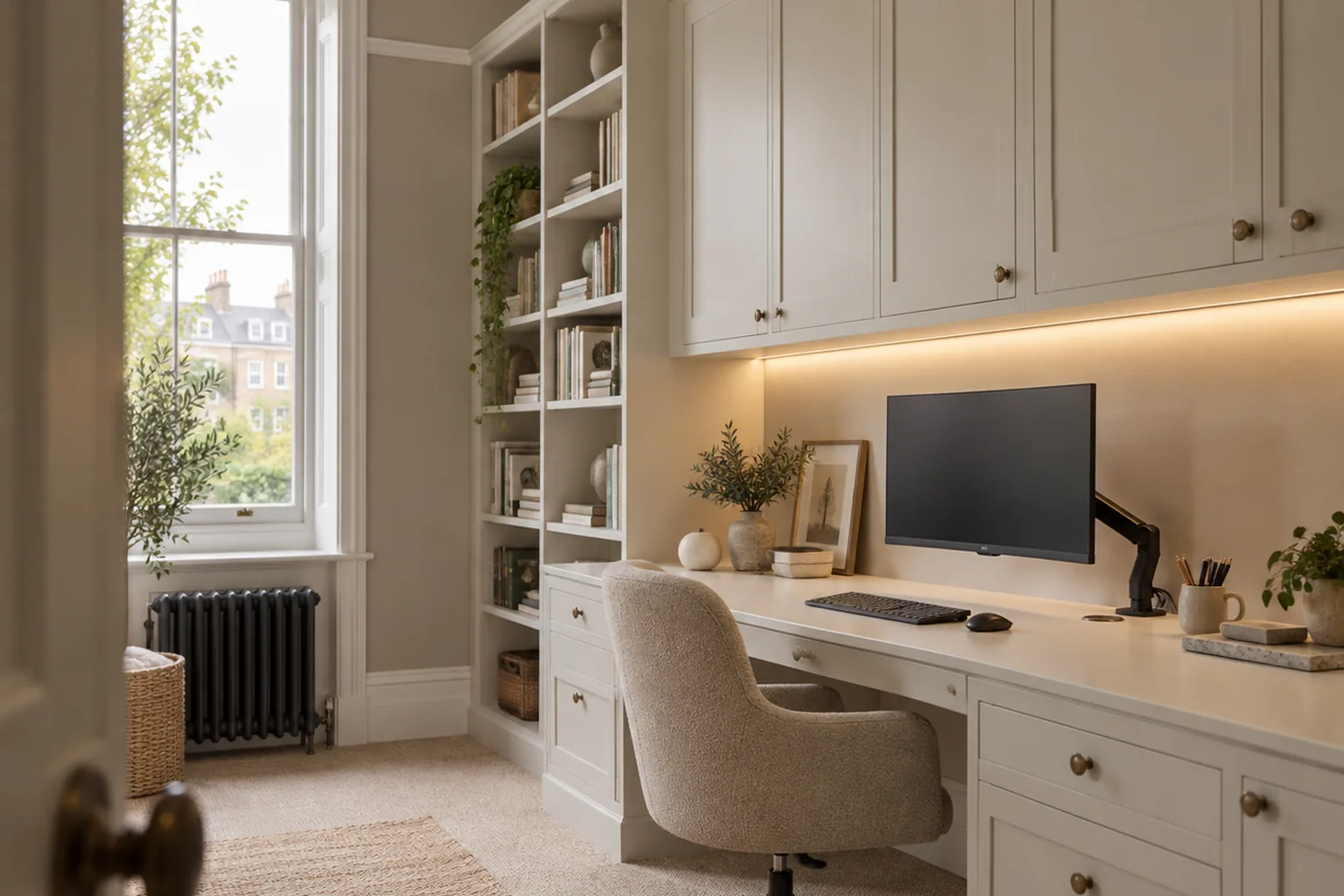
Desk wall from a local joiner £900–£3,000, floor-to-ceiling study wall £3,500–£10,000+, IKEA flat-pack £200–£600. A 2.4m study wall lands at £4,500–£5,000 installed.
Employees cannot claim working-from-home relief from 6 April 2026 — the route is now employer reimbursement. Sole traders claim £10–£26/month; companies can still buy furniture tax-efficiently.
A single study wall saves £1,676 in our worked example — but only because freight spreads across a consolidated shipment. On its own, a local joiner usually wins; bundled with other rooms, the saving widens past £2,000.
A fitted home office in the UK costs anywhere from £200 for an IKEA flat-pack combination to £10,000+ for a floor-to-ceiling bespoke study wall. Between those poles sit built-in desk walls from local joiners at £900–£3,000 and national-brand fitted studies from around £3,000. What no published UK cost guide covers — and what this one does — is the tax layer: 2026/27 is the first tax year in which employees can no longer claim working-from-home relief, which changes the arithmetic for everyone buying office furniture this year.
This guide does three things most cost guides skip: it prices a 2.4m study wall line by line (local joiner vs factory-direct import), explains what drives the quote in a room where sockets and cable routing matter as much as shelving, and sets out the 2026/27 tax rules for sole traders, employees and limited company directors — each figure checked against current GOV.UK guidance.
Key takeaways
Four routes exist, and they barely overlap on price. Published figures from UK suppliers and cost guides, October 2026:
| Route | Typical cost | What you get | Lead time |
|---|---|---|---|
| IKEA flat-pack combination | £200–£600 | KALLAX shelving, ALEX drawer units and a desktop; self-assembly, self-planned cable runs | Same week |
| Online made-to-measure suppliers | From £900 | Cut-to-size desk and storage units made to your measurements, delivered flat-packed | 2–4 weeks |
| Local joiner, fitted | £900–£3,000 desk wall / £3,500–£10,000 full study wall | Site-measured, scribed to your walls, sockets and task lighting integrated | 2–4 weeks |
| National brand (Sharps etc.) | From £3,000 | Showroom design visit, full installation, long guarantee | 4–8 weeks |
Sources: Checkatrade home library cost guide (May 2024) — built-in bookshelves £900–£3,000 (avg £1,950), floor-to-ceiling bespoke £3,500–£10,000 (avg £6,750); MyBuilder home library guide — £1,000–£20,000+ by specification tier; online-bedrooms Linby desk from £900 (search-listing snippet); Sharps bedroom-office equivalent from £3,000. Full links in Methodology.
Two honest observations from these numbers. First, no UK cost-guide publisher maintains a dedicated fitted-home-office price page — Checkatrade and MyBuilder's closest equivalents price bookshelves and libraries, so this guide leans on those published figures and labels every extrapolation. Second, the IKEA line and the joiner line don't compete for the same project: £600 of flat-pack can't carry a printer tower, 3m of hidden cable routing and a floor-to-ceiling bookcase, while £4,000 of joinery is overkill for a laptop and a lamp.
What the table doesn't show is the fifth route — factory-direct custom import — because no published UK price list covers it. That's what the worked example prices.
The most common home-office project we quote: a spare room with a 2.4m clear wall — a continuous desk run with pedestal drawers, wall cabinets above, a 1.8m floor-to-ceiling bookcase on the return, cable management, and LED task lighting. Painted MDF throughout.
| Line item | Local joiner | Bespoke import |
|---|---|---|
| Design & site survey | £150 | £0 (you measure, we draw) |
| Desk run with pedestal drawers (2.4m, painted MDF) | £1,400 | £620 (FOB) |
| Wall cabinets over the desk (2.4m) | £750 | £330 (FOB) |
| Floor-to-ceiling bookcase (1.8m run) | £1,100 | £480 (FOB) |
| Cable management, sockets & LED task lighting | £250 | £110 (FOB) |
| Sprayed finish | £450 | Included in FOB |
| Installation (2 joiner-days) | £540 | £540 |
| Electrician (socket & lighting circuit) | £150 | £150 |
| Sea freight (share of consolidated 40ft) | — | £280 |
| UK delivery & customs clearance | — | £240 |
| Import duty (HS 9403 30, 0%) | — | £0 |
| Import VAT (20%, on goods + freight) | — | £364 |
| Total | £4,790 | £3,114 |
Import column assumes you arrange installation locally — two joiner-days at £270/day, within MyBuilder's published range of £150–£300/day, plus an electrician at mid-range rates. FOB figures are illustrative market benchmarks for comparable specification, not a George Group quotation. Freight priced as a share of a consolidated 40ft container (Drewry World Container Index Shanghai→Rotterdam US$3,337, 8 October 2026).
The import route saves roughly £1,676 on this wall — real money, but read the caveats before getting excited. It adds 8–12 weeks of lead time, puts the measuring responsibility on you, and the saving only exists because the freight and clearance costs (£520) are spread across a consolidated shipment. For a single study wall on its own, a local joiner is usually the saner choice — the bundling arithmetic comes later in this guide.
Pricing a home office right now? Send us your room dimensions and equipment list → — we return an itemised quotation within 24 hours.
Two quotes for "the same" home office can differ by £2,000+. These are the variables that move the number:
| Cost driver | Typical impact | Notes |
|---|---|---|
| Linear metres of cabinetry | Base cost × metres | Shelving from £70/m in MDF or plywood, up to £230/m in hardwood (Checkatrade); full study walls price 4× a desk-wall run |
| Cable routing & sockets | +£50–£300 | Chasing walls, adding a socket circuit behind the desk run (MyBuilder electrical works range) |
| Integrated task lighting | +£100–£300 | Under-cabinet strips and shelf lighting (MyBuilder range) |
| Drawer pedestals & towers | +£200–£600 per unit | Cabinet-grade pricing per MyBuilder component ranges |
| Desk-wall vs full study wall | £900–£3,000 vs £3,500–£10,000+ | The single biggest fork in the quote (Checkatrade tiers) |
| Room shape | +10–20% | Loft sloped ceilings, alcoves, chimney breasts |
| Equipment specification | Quote-dependent | Printer towers need 600mm-deep bases; dual-monitor arms need reinforced worktops |
Trade estimates where marked, based on published component ranges and typical labour rates, October 2026 — see Methodology.
The driver that separates a home office from every other fitted job is the cable route. A wardrobe needs nothing behind it; a desk run wants sockets at desktop height, a grommet in the worktop, and often a fused spur for lighting — which is why the electrician line appears in almost every quote we see. The second home-office-specific lever is the equipment list: a printer tower needs a 600mm-deep base cabinet, dual-monitor arms need a reinforced worktop, and neither has an IKEA equivalent at any price.
Honesty first: if your budget is under £1,000 and your room is a square new-build, an IKEA combination is the right answer. A KALLAX shelving unit (77×147cm) currently costs £49, an ALEX drawer unit adds cable-friendly drawer storage, and a desktop runs £55–£150 — the whole combination lands well under £600, and no custom joinery competes at that price. Any guide that pretends otherwise is selling something.
The comparison is about what you give up:
| Factor | IKEA flat-pack | Fitted custom |
|---|---|---|
| Worktop | Fixed sizes (e.g. 160×80cm) | Any length and depth, cut to the wall |
| Storage modules | Fixed cells — KALLAX 77×147cm, ALEX drawer heights | Built to your equipment list, to the millimetre |
| Cable management | Drill your own grommets; visible trunking | Routed grommets, hidden sockets, in-cabinet power planned in the drawings |
| Equipment loads | Shelf ratings limit printer towers and monitor arms | Engineered for the load you list |
| Ceiling height | Freestanding units stop at fixed heights | Floor-to-ceiling — typically +40cm of top-box storage |
| Skirting & obstacles | Stand off the wall or notch by hand | Scribed to skirting, picture rails, sloped ceilings |
| Price (2.4m desk wall with drawers + cabinets) | £200–£600 | £2,500–£4,500 installed |
| Best for | Square rooms, budgets under £1,000, renters | Period walls, integrated power, maximum storage |
IKEA figures from IKEA UK's published pricing (KALLAX 77×147cm at £49, October 2026); custom column reflects standard trade specification. See Methodology.
The dividing line is exactly where UK housing is least cooperative: skirting boards you have to notch by hand, walls that aren't square, sockets in the wrong place, and no clean way to hide a cable run. Each workaround costs you either storage or looks. In a genuinely square room with sockets where you want them, those problems don't exist and the £2,000+ you save with IKEA is real money.
The middle option worth knowing: hybrid. IKEA storage on the straight runs, a custom worktop with a joiner-cut cable grommet, a custom top box over the shelving. Typically £800–£1,500 all-in — and the pragmatic answer for a lot of homes.
2026/27 is a watershed year for home-office tax. From 6 April 2026, employees can no longer claim tax relief for working from home: GOV.UK states plainly that for the tax year 6 April 2026 to 5 April 2027 "you will not be able to claim tax relief for working from home", with claims still possible for the four previous tax years. The abolished relief was worth £6 a week — £1.20 a week for a basic-rate taxpayer. What remains for employees is the employer reimbursement route; for the self-employed and company owners, the rules carry on as before.
| Your situation | What you can claim | The numbers |
|---|---|---|
| Sole trader — simplified expenses | Flat monthly rate for hours worked from home | £10/month (25–50h), £18 (51–100h), £26 (101h+); phone & broadband claimed separately by business-use % |
| Sole trader — traditional accounting | Furniture via capital allowances | Annual investment allowance: 100% of up to £1m of plant and machinery; qualifying fixtures per GOV.UK include "fitted kitchens or bathroom suites" |
| Employee | Working-from-home relief | Abolished from 6 April 2026; back-claims open for the 4 previous tax years; employer reimbursement remains |
| Limited company director | Company buys the furniture; employer pays homeworking costs | £6/week (or £26/month) tax-free; company-owned furniture: no BIK where private use isn't significant, otherwise annual value = 20% of market value |
Sole traders. Two mechanisms. Under simplified expenses, you claim a flat monthly amount based on hours worked from home — £10 for 25–50 hours, £18 for 51–100, £26 above 100 — with a 25-hour monthly minimum; phone and internet sit outside the flat rate and are claimed as a business-use percentage. Under traditional accounting, furniture can instead go through capital allowances: the annual investment allowance covers 100% of up to £1m of plant and machinery, and GOV.UK's own examples of qualifying fixtures are "fitted kitchens or bathroom suites". Whether fitted office furniture qualifies depends on how permanently it's fixed and the business-use split — a question for your accountant, not for a furniture guide. (Note also: sole traders using cash basis can only claim capital allowances on business cars.)
Employees. The £6-a-week relief is gone for 2026/27; back-claims remain open for the four previous tax years, and only if your employer required you to work from home — choosing to doesn't count. The live route is employer reimbursement: your employer can pay for homeworking equipment — office furniture is explicitly included — plus contribute to household bills, tax-free. In practice, for employees the company should buy the desk, not the person.
Limited company directors. The company can pay you £6 a week (or £26 a month) tax-free towards homeworking costs. Where the company buys the furniture and it sits in your home, treatment hinges on private use: where private use is not significant, no benefit-in-kind arises; where it is significant, the annual value is 20% of the item's market value when first provided — on a £4,000 study wall, £800 a year of taxable benefit. Capital allowances can apply to qualifying fixtures on the same basis as above.
This section summarises published GOV.UK guidance accessed October 2026; it is not tax advice. Confirm your position with your accountant before claiming anything.
If you've ruled out flat-pack, this is the real decision — and the honest answer is less convenient for us than you'd expect.
| Factor | Local joiner | Bespoke import (e.g. China factory) |
|---|---|---|
| Price (2.4m study wall) | £4,500–£5,000 | £3,100–£3,500 landed + local fitting |
| Lead time | 2–4 weeks from order | 8–12 weeks (production + sea freight) |
| Site survey | Included | You measure (with our measuring guide) |
| Installation | Included | You arrange local fitters (£150–£300/day) |
| Sockets & cable routing | Electrician on site, natural | Planned into drawings, fitted locally |
| Design revisions | In person | Drawings by email, 48-hour turnaround |
| Best for | Single room, tight timeline, difficult walls | Whole-house joinery packages |
The honest answer: for a single study wall, hire a local joiner. The £1,676 saving in the worked example only holds when freight and clearance spread across a bigger shipment — on a lone room you'd take on the measuring risk, the 8–12 week wait, and the job of coordinating fitters and an electrician for a saving that mostly evaporates.
The economics flip when the office is one room in a whole-house package — the same container carrying bedroom wardrobes, a kitchen, or a media wall for the living room. Freight and clearance are fixed costs: spread across five rooms, the per-room landed saving widens to £2,000+, and the arithmetic turns decisively, as our full import cost breakdown shows line by line. The walk-in wardrobe economics work identically.
The process is the same whether you go local, modular or import. Five steps — the first two are home-office specific:
The Irish market tracks the UK with three differences.
VAT depends on what you're buying. Furniture supplied as goods is standard-rated at 23%; where fitted furniture is supplied and installed as a service, the 13.5% reduced rate generally applies — both rates sit on Revenue's current rates table (updated 1 January 2026). On a €5,000 fitted office, the difference between the two treatments is €475.
Prices run a little higher. A fitted home office from a Dublin specialist starts around €5,700–€6,100 (custommade.ie listing, indicative); per-metre pricing from fitted-furniture makers runs roughly €550–€1,700 per metre in MDF and €1,700–€4,500 in solid wood.
The tax rules are more generous — but exclude the furniture. Ireland's e-working allowance lets employers pay €3.20 a day tax-free, and Remote Working Relief lets employees attribute 30% of electricity, heating and broadband costs against their highest marginal rate. But Revenue is explicit about capital items: "Capital items such as laptops, computers, office equipment and office furniture purchased by you are not allowable costs." For an Irish employee the furniture itself is never deductible — the same conclusion the UK reaches, just stated more plainly.
The import route works identically — delivery via Dublin Port, VAT at 23% on the landed value, and the bundling logic matters even more with joiner rates higher.
George Group manufactures bespoke joinery — wardrobes, home offices, kitchens, media walls — in our own factory and ships directly to the UK and Ireland. No showroom, no national sales team, no franchise markup: factory-direct pricing on joinery built to your exact room dimensions.
Every home office starts from your room dimensions and your equipment list. We draw the room in 2D and 3D with sockets, cable routes and grommet positions planned into the drawings; you approve the layout; and we manufacture to those drawings — worktops pre-drilled, cable management pre-fitted where possible, panels labelled to the packing list so a local fitting team and an electrician can complete the room in one to two days.
We don't publish fixed prices because no two rooms are the same. What we commit to is an itemised quotation — carcasses, worktop, drawers, lighting, cable management, freight, installation guidance — that you can compare line for line against any joiner or brand quote. And if the honest answer is that a local joiner or an IKEA combination fits your project better, we'll say so — as this guide has.
Explore the wardrobe and storage range for finish quality and interior options, or see how the design process works from first measurements to installation drawings.
UK pricing compiled in October 2026 from: Checkatrade's home library cost guide (May 2024 — freestanding bookcases £140–£1,250, built-in bookshelves £900–£3,000 averaging £1,950, floor-to-ceiling bespoke £3,500–£10,000 averaging £6,750), Checkatrade's custom built-in shelves guide (shelving from £70/m in MDF or plywood, up to £230/m hardwood), MyBuilder's home library price guide (£1,000–£20,000+ across four specification tiers; carpenters £150–£300/day, electricians £40–£60/hour) and its bookshelf installation guide (built-in bookshelves £1,500–£5,500; electrical works £50–£300; integrated lighting £100–£300), Sharps published bedroom-office pricing from £3,000, and Hammonds' £1,500 minimum order as compiled in our brand comparison. The online-bedrooms Linby desk (£900) is quoted from a search-listing snippet and labelled as such. IKEA figures from IKEA UK's published pricing (KALLAX 77×147cm shelving at £49, reduced from £60; desktops £55–£150), accessed October 2026 via IKEA UK.
Import figures: finished wooden office furniture (HS 9403 30) enters the UK at 0% third-country duty, verified against the UK Trade Tariff heading 9403 (date of trade 12 October 2026), with import VAT at 20% on goods plus freight. Flat-pack/CKD shipments of parts fall under a different commodity code with a different duty rate — worth checking if you're importing disassembled components. Sea freight benchmark: Drewry World Container Index, Shanghai→Rotterdam US$3,337 per 40ft (8 October 2026), used at a share-of-consolidated-container basis in the worked example.
Tax rules verified October 2026 against GOV.UK: employee working-from-home relief (abolition notice), simplified expenses working from home, capital allowances — what you can claim on (AIA £1m; fixtures "for example fitted kitchens or bathroom suites"; cash-basis restriction to business cars), employer homeworking expenses (office furniture explicitly included), and valuing assets provided to employees (annual value 20% of market value). Irish rules from Revenue's e-working allowance (€3.20/day), Remote Working Relief (30% attribution; capital items including office furniture explicitly not allowable), and current VAT rates. Irish price anchors: custommade.ie fitted home office €5,700–€6,100 (search-listing snippet, indicative) and alocokitchens.ie per-metre pricing (€550–€1,700 MDF, €1,700–€4,500 solid wood).
Cost-driver figures marked as trade estimates are based on published component ranges and typical labour rates; they are not from a single published source and are labelled as such. All prices are market benchmarks, not George Group quotations — your itemised quote will depend on your room dimensions, equipment list and finish choices. Nothing in this article is tax advice.
From £900 to £3,000 for a built-in desk wall (Checkatrade's built-in bookshelf range, which is the closest published equivalent), and £3,500–£10,000+ for a floor-to-ceiling bespoke study wall. An IKEA flat-pack combination costs £200–£600; national brands start around £3,000. A 2.4m study wall from a local joiner typically lands at £4,500–£5,000 all-in.
Depends who you are. Sole traders can claim either the simplified flat rate (£10–£26/month by hours worked from home) or, under traditional accounting, capital allowances on qualifying furniture. Employees cannot claim working-from-home relief from 6 April 2026 — that route is abolished for 2026/27 — and should instead ask their employer to provide or reimburse the equipment. Limited companies can buy the furniture as a company asset, subject to benefit-in-kind rules. Confirm specifics with your accountant.
Yes, with conditions. Where the furniture is provided to an employee or director who works from home and private use is not significant, no benefit-in-kind arises. Where private use is significant, the annual taxable value is 20% of the item's market value when first provided — £800 a year on a £4,000 study wall. The company may also claim capital allowances on qualifying fixtures; GOV.UK's published fixture examples are fitted kitchens or bathroom suites, so treatment of fitted office furniture specifically depends on how it's fixed and how it's used.
A fitted home office from a Dublin specialist starts around €5,700–€6,100, with per-metre pricing from fitted-furniture makers of roughly €550–€1,700 in MDF and €1,700–€4,500 in solid wood. VAT is 23% on furniture as goods and generally 13.5% where supplied and installed as a service.
Honestly, yes — if your budget is under £1,000 and your room is a square new-build. A KALLAX shelving unit at £49, an ALEX drawer unit and a £55–£150 desktop make a workable office for under £600. IKEA loses its advantage where you need floor-to-ceiling storage, hidden cable routing, reinforced worktops for heavy equipment, or furniture that scribes to skirting boards and sloped ceilings.
Employees can no longer claim tax relief for working from home. GOV.UK states that for the tax year 6 April 2026 to 5 April 2027 you will not be able to claim the relief, though claims remain open for the four previous tax years (and only where your employer required you to work from home). The replacement route for employees is employer reimbursement of homeworking costs, including office furniture.
A local joiner typically delivers in 2–4 weeks from order. A bespoke import takes 8–12 weeks including production and sea freight, plus local installation afterwards — budget an extra day or two for the electrician's visit either way.
We haven't found published UK estate-agent data isolating home offices, so treat any percentage claim with caution. The practical trade-off is room function: converting a bedroom to a study removes a bedroom from the listing, which matters in family-house markets, while converting a box room or adding joinery to an underused space generally helps presentation. The safest framing: a fitted home office adds saleability more reliably than it adds headline value — an estimate, not a rule.
What to confirm before ordering kitchen cabinets from China for a UK project: real costs, specifications, quality checks and a simple enquiry pack.
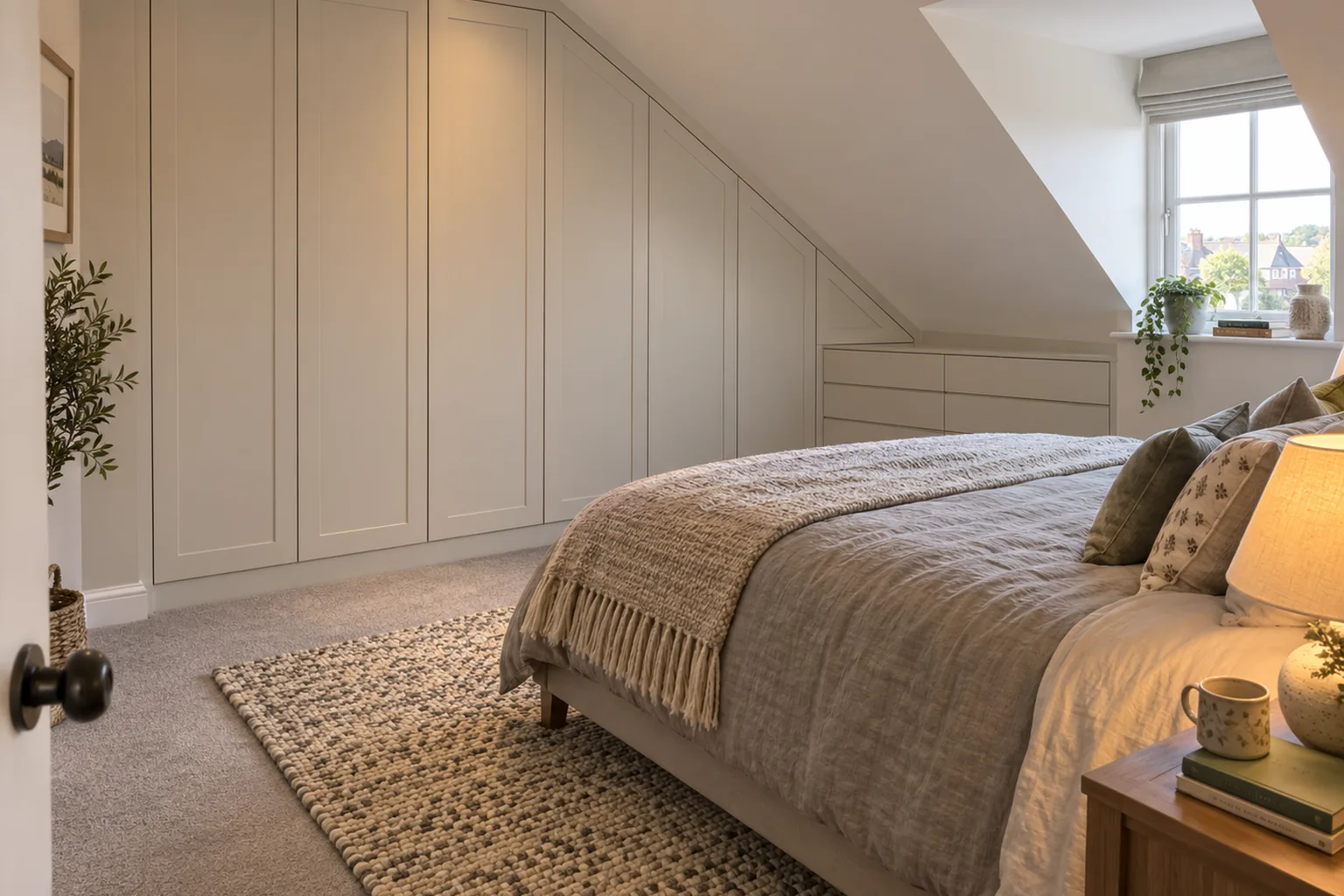
Read the guideSloping ceiling wardrobes cost £1,500–£5,999 fitted in the UK. Compare ready-made, specialist and import prices for loft and eaves runs, with worked examples.
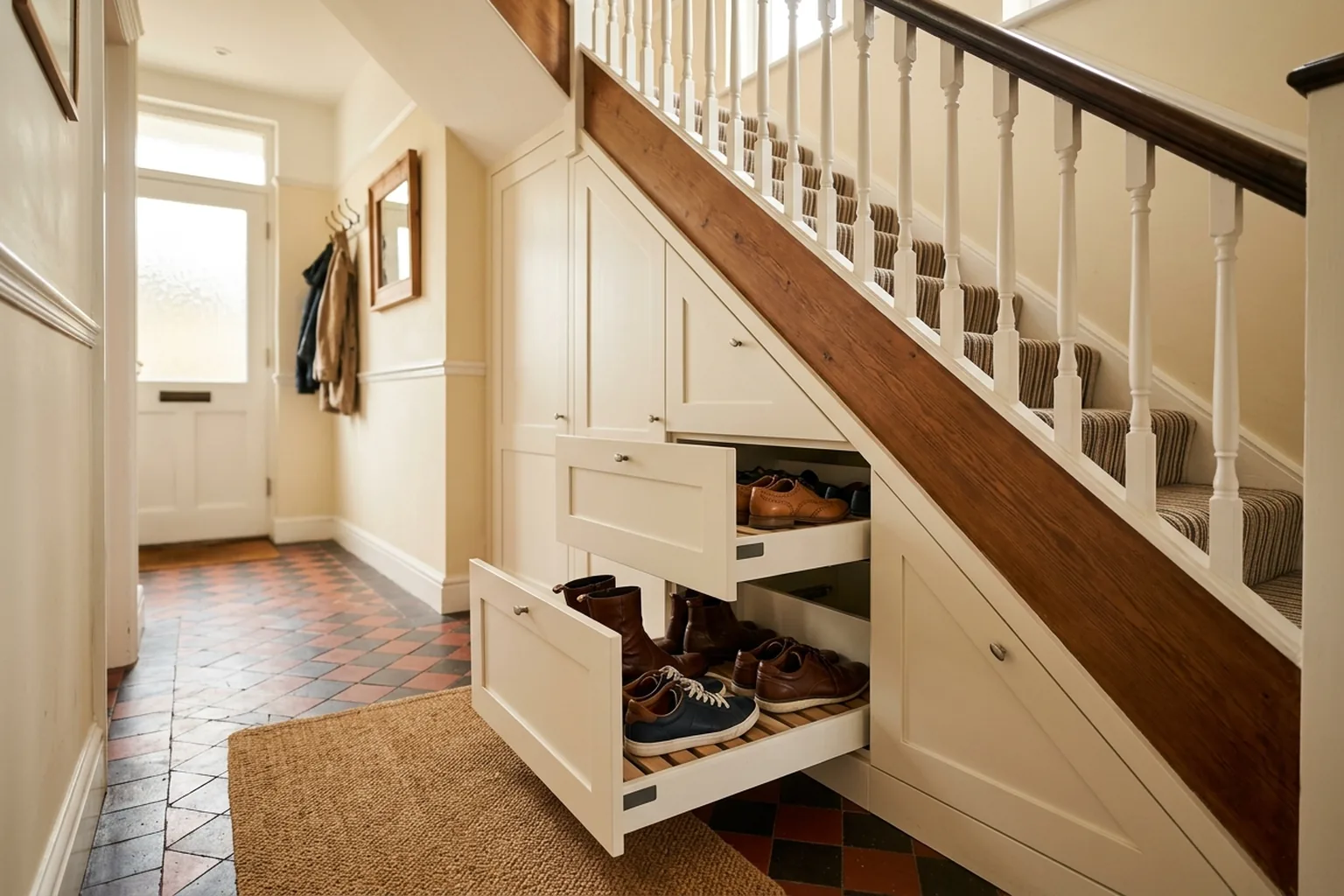
Read the guideUnder stairs storage costs £250–£8,000 in the UK. Compare specialist, joiner and import prices, worked examples, regulations and when importing pays.
Read the guideSend your drawings or a short brief — a dedicated coordinator replies with next steps and a consolidated quote.