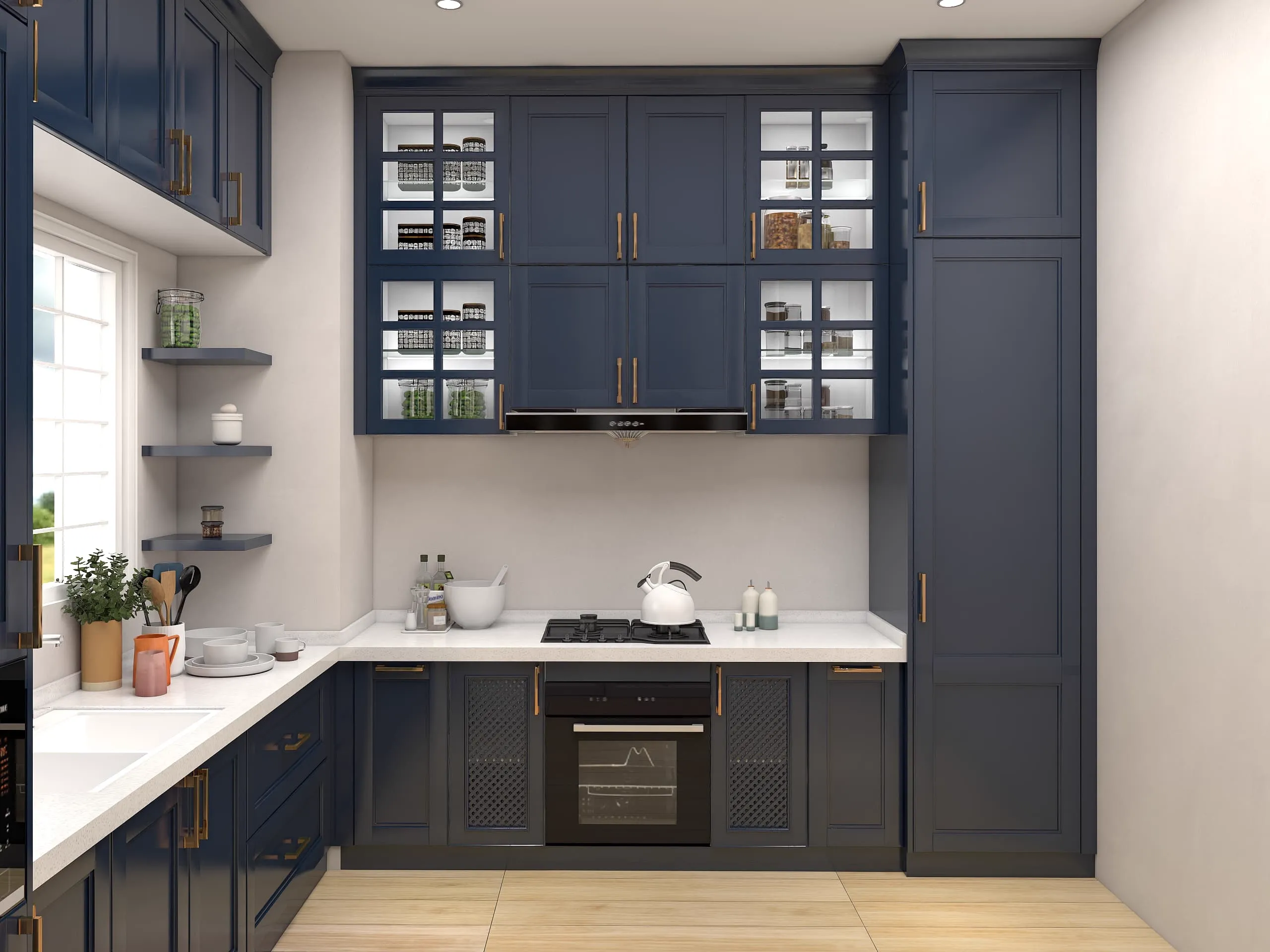
Kitchen Cabinets from China: A UK Specification and Enquiry Guide
What to confirm before ordering kitchen cabinets from China for a UK project: real costs, specifications, quality checks and a simple enquiry pack.
Read the guideUK media wall costs: £2,000–£4,000 custom, £2,300–£3,500 with electric fire. Line-item breakdown, Part P rules and joiner vs import compared.

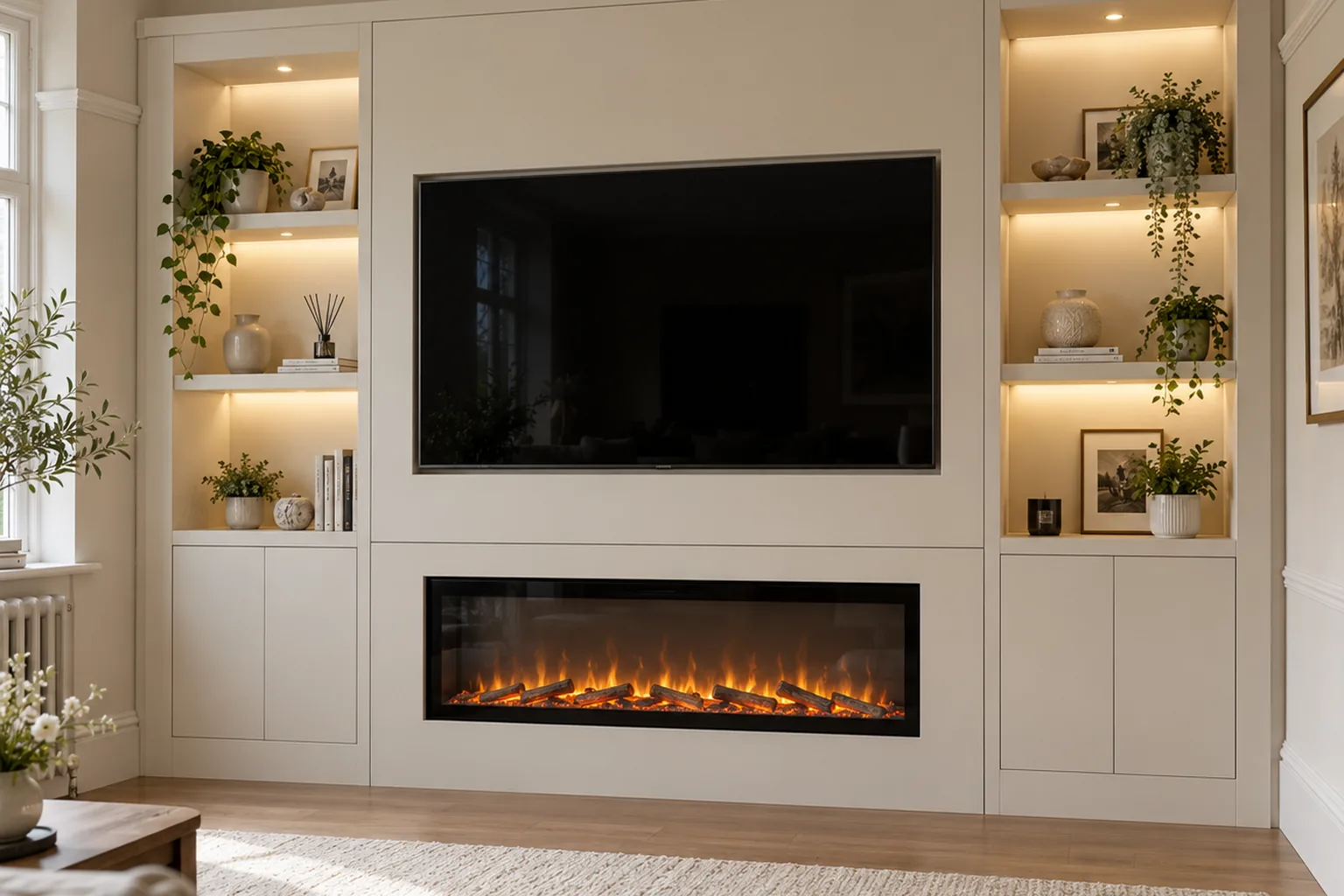
Five cost guides converge on £2,000–£4,000 for a custom media wall; add £300–£500 for an electric fire recess.
Electric fires produce no combustion products, so Part J is irrelevant. The electrical connection must meet Part P.
One media wall: local joiner. Media wall bundled with wardrobes and kitchen in one shipment: factory-direct saves £1,000+ per room.
A media wall in the UK costs between £2,000 and £4,000 for a standard custom build, rising to £2,300–£3,500 when you include an electric fire recess. That's the figure five separate cost guides converge on. What they don't tell you is why two quotes for the same wall can differ by £1,500, or when importing a bespoke unit from a factory actually beats hiring a local joiner — and when it doesn't.
This guide breaks the cost down line by line, covers the Building Regulations that actually apply to electric fire recesses (they're not what most people think), and gives you an honest local-vs-import comparison so you can decide which route fits your project.
Five independent sources published media wall pricing in 2024–2026. The spread is wide at the edges but the centre of gravity is consistent.
| Build tier | Checkatrade | mediawallmaster | MyBuilder | nobaandstod | devin-furniture |
|---|---|---|---|---|---|
| Flat-pack / pre-built | — | — | — | £400–£1,500 | — |
| Basic custom (no fire) | £2,000–£4,000 | £2,000–£6,000 | £2,000–£4,000 | £1,200–£3,500 | £1,500 per linear m |
| Custom with electric fire | £2,300–£3,500 | — | — | — | — |
| Stud / false wall (per m²) | £55–£65 | — | — | — | — |
Sources linked in Methodology. Facebook buyer threads (2024–2026) report £900–£1,500 for mainstream installs and £500–£600 for DIY — real but unverified.
The takeaway: £2,000–£4,000 is the honest mid-range for a professionally built custom media wall. Anything under £1,500 is either flat-pack, DIY, or a very small wall. Anything over £5,000 is large-format, premium finishes, or includes significant electrical and structural work.
To make this concrete, here is what a realistic mid-spec job looks like: 3.5m wide living room wall, recessed electric fire (1,000mm wide), TV mounted above (65"), hidden cable management, painted MDF finish, built into a new stud wall on a 1930s semi.
| Line item | Local joiner | Bespoke import |
|---|---|---|
| Design & survey | £200 | £0 (you measure, we draw) |
| Stud wall frame & plasterboard (3.5m × 2.4m ≈ 8.4m² @ £60/m²) | £500 | £500 (local builder) |
| Custom carcass & panelling | £1,400 | £650 (FOB) |
| Electric fire recess framing & finishing | £350 | Included in carcass |
| Cable management & first-fix electrics | £280 | £280 (local electrician) |
| Painted finish (2-pack spray) | £420 | Included in FOB |
| Sea freight (share of 40ft container) | — | £180 |
| UK delivery & installation | £450 | £520 |
| Import duty (HS 9403601000, 0%) | — | £0 |
| Import VAT (20%, recoverable if VAT-registered) | — | £166 |
| Total | £3,600 | £2,296 |
Import column assumes you coordinate the stud wall, electrics and installation locally; the factory supplies the finished carcass and panelling. Figures are illustrative, not a George Group quotation.
The import route saves roughly £1,300 on this specification — but it adds 8–12 weeks of lead time and requires you to project-manage three separate trades (builder, electrician, installer) instead of one joiner doing everything.
Pricing a media wall right now? Send us your wall width, TV size and fire model → — we return an itemised quotation within 24 hours.
Two quotes for "the same" media wall can legitimately differ by £1,500. These are the variables that move the number.
| Cost driver | Typical impact | Notes |
|---|---|---|
| Electric fire recess | +£300–£500 | Framing, finishing, ventilation clearance |
| Hidden cable management | +£150–£300 | First-fix routing, brush plates, HDMI conduit |
| Timber veneer finish | +35–45% over painted MDF | Real oak or walnut veneer vs spray-painted MDF |
| Stone or porcelain worktop | +£400–£800 | 20mm quartz or sintered stone shelf above fire |
| Acoustic slat panelling | +£200–£400 per section | Timber battens on acoustic felt backing |
| Stud wall construction | £55–£65 per m² | Only if the wall doesn't already exist |
| TV size / weight | Minimal | A 75" TV bracket costs £40 more than a 55" bracket — negligible |
| Integrated LED lighting | +£120–£250 | Recessed strip lighting in shelving niches |
Figures marked +£ are trade estimates based on material differentials and typical labour rates, October 2026. The stud wall figure is Checkatrade's published rate.
The two biggest cost levers are finish material and fire integration. Choosing painted MDF over real veneer typically saves £500–£800 on a 3.5m wall. Omitting the fire recess saves £300–£500. Everything else is secondary.
What doesn't move the price much: TV brand, bracket type, or the number of shelves. Those are hardware costs, and hardware is cheap relative to labour and materials.
This is where most online guides get it wrong. The rules for an electric fire in a media wall are fundamentally different from a gas fire or wood burner.
An electric fire needs no flue, no chimney, and no Part J compliance certificate. Part J of the Building Regulations covers combustion appliances — anything that burns fuel and produces exhaust gases. An electric fire is a resistive heater with an LED flame effect. It produces no combustion products, so it falls outside Part J entirely.
What does apply:
Part P (Electrical Safety). The fire needs a dedicated electrical connection, typically via a fused spur, installed to current wiring regulations. In England, most domestic electrical work must either be carried out by a Part P registered electrician or inspected by Building Control. In practice, this is usually handled as part of the media wall's first-fix electrics.
Manufacturer clearances. Even without a flue, the fire unit generates heat in heating mode. Every manufacturer publishes minimum clearance distances — top, sides, and any shelf or surface directly above the unit. These vary by model but typically require 100–300mm above and 50–100mm on each side. Ignore them and you risk warping the surround or, in the worst case, a thermal cut-out fault. Your media wall design must be built around the specific fire model's installation manual, not the other way around.
Structural framing. The recess must be framed to the fire manufacturer's exact opening dimensions, with adequate support above and around the unit. Slimline media wall fires are typically 40–70mm deep and designed to sit flush within a stud or timber frame — they are not freestanding appliances.
Fire safety (Approved Document B). While the fire itself doesn't need Part J compliance, the general fire safety provisions of Approved Document B still apply to the materials used in the wall construction — particularly if you're using timber framing and combustible finishes near a heat source.
VESA mounting. Virtually all flat-screen TVs use the VESA mounting standard — a square or rectangular pattern of threaded holes on the back of the TV. Common patterns are 200×200mm, 400×400mm and 600×400mm. The mount you need depends on your TV's VESA pattern and weight. A 65" TV typically weighs 20–28kg and needs a mount rated for at least 35kg. This is standard hardware, not a design constraint — but your media wall frame must be built to take the load.
Wall type matters more than TV size. UK period housing (Victorian, Edwardian, 1930s semis) typically has solid brick or block walls in the living room — these take a TV mount without issue. Newer builds and some internal walls use timber stud with plasterboard, which requires the mount to be fixed into the studs or into a reinforced plywood backer panel behind the plasterboard. If you're building a new stud wall for the media wall, specify a 12–18mm plywood backer at the TV position during framing. Retrofitting reinforcement after plastering is significantly more expensive.
Hidden wiring is a first-fix decision. Every cable — power, HDMI, optical audio, ethernet, soundbar — needs to be routed before the plasterboard goes up. Retrofitting hidden cable management into a finished media wall means cutting into plasterboard, which is messy and expensive. Plan for: one double socket behind the TV position, one fused spur for the electric fire, HDMI conduit from TV to cabinet, and a dedicated soundbar feed if you're using one.
| Compliance checkpoint | What applies | Who's responsible |
|---|---|---|
| Electrical installation | Part P (England) | Registered electrician |
| Fire unit clearances | Manufacturer installation manual | Joiner / designer |
| TV mount load rating | VESA standard + TV weight | Joiner / installer |
| Wall type (solid vs stud) | Structural adequacy | Builder / surveyor |
| Materials near heat source | Approved Document B | Joiner / designer |
This is the decision most buyers actually face — and where most cost guides go silent, because the people writing them are either local joiners or national brands with a vested interest in the answer.
| Factor | Local joiner | Bespoke import (e.g. China factory) |
|---|---|---|
| Price (3.5m, mid-spec) | £3,200–£4,000 | £2,000–£2,600 landed |
| Lead time | 2–4 weeks from order | 8–12 weeks (production + sea freight) |
| Site survey | Included | You measure (or we guide you) |
| Installation | Included | You arrange locally |
| Electrical first-fix | Usually coordinated | You coordinate |
| Aftercare | Local, one call | Spare panels + UK fitting partners |
| Best for | Single media wall, tight timeline | Bundled with wardrobes, kitchen, other joinery |
The honest answer: if you want one media wall and you want it done within a month, hire a good local joiner. The £1,000–£1,400 you might save on the carcass by importing doesn't compensate for the coordination overhead and the 8–12 week wait.
The import route makes sense when the media wall is one part of a larger joinery package — fitted wardrobes in the bedrooms, a kitchen, bathroom vanities, or a fitted home office in the spare room — all manufactured together, shipped in the same container, and installed in the same visit. At that scale, the per-unit saving compounds and the fixed costs (freight, customs, installation team) are spread across five or six rooms instead of one wall.
For the full landed-cost breakdown including freight rates, port charges and VAT treatment, see our China vs UK joiners cost comparison.
Whether you go local or import, the process follows the same five steps.
Ready to start? Send your wall measurements and fire model → — drawings within 48 hours, itemised quote within 24 hours of design confirmation.
The Irish market follows the same cost structure as the UK, with two material differences.
VAT is 23%, not 20%. This applies to both materials and labour. On a €3,500 media wall, that's €805 in VAT versus £700 on the UK equivalent. The Revenue Commissioners publish current VAT rates — construction services are generally at the standard rate unless the project qualifies as a renovation under the two-thirds rule.
Period housing stock differs. Dublin's Georgian and Victorian terraces share the solid-wall construction of their UK counterparts, but many Irish homes built in the 1960s–80s use cavity block construction that behaves differently from UK brick when mounting heavy loads. If your house was built after 1960, confirm the wall construction before specifying the TV mount.
A bespoke media wall in Ireland typically costs €2,500–€4,500 from a local joiner, roughly 10–15% above UK prices, reflecting both the VAT differential and higher Dublin labour rates.
George Group manufactures bespoke joinery — wardrobes, kitchens, media walls, bathroom vanities — in our own factory and ships directly to the UK and Ireland. There is no showroom, no national sales team, and no franchise markup. What you get is factory-direct pricing on furniture built to your exact measurements.
Every media wall we produce starts from your wall dimensions, your TV, and your chosen fire model. We draw the unit in 2D and 3D, you approve the design, and we manufacture to those drawings. The carcass arrives pre-finished, pre-drilled for your TV bracket and fire recess, ready for a local installer to fit in one to two days.
We don't publish fixed prices because every wall is different. What we commit to is an itemised quotation — carcass, finish, fire recess, freight, installation guidance — that you can compare line-for-line against any local quote. If our number isn't competitive on your specific project, we'll tell you.
Explore our wardrobe and storage range for an idea of the finish quality and interior options we build to, or see how our design process works from first measurements to installation drawings.
UK media wall pricing compiled in October 2026 from Checkatrade's media wall cost guide (£2,000–£4,000 standard, £2,300–£3,500 with fireplace, stud wall £55–65/m², May 2024 data), mediawallmaster.co.uk pricing guide (£2,000–£6,000, 2026), MyBuilder media wall costs (£2,000–£4,000, 2026), nobaandstod.co.uk (£400–£1,500 flat-pack, £1,200–£3,500+ custom, 2026), and devin-furniture.co.uk (£1,500 per linear metre, 2026). Buyer-reported figures from Facebook groups and forums are noted as texture, not benchmarks.
Electric fire compliance guidance based on GOV.UK Approved Document P (electrical safety in dwellings), GOV.UK Approved Document B (fire safety), and manufacturer installation manuals. The electric fire installation overview draws on Smart Space Living's media wall fire guide (slimline 40–70mm depth, fused spur connection, no flue required).
Import duty classification: GOV.UK Trade Tariff commodity 9403601000 (wooden furniture of a kind used in the living room), third-country duty rate 0% — consistent with the broader HS 9403 wooden furniture chapter. Sea freight benchmark: Drewry World Container Index Shanghai→North Europe US$3,626 per 40ft (17 September 2026, as used in our landed cost analysis). Irish VAT from Revenue.ie (23%, accessed October 2026).
Cost driver figures marked as trade estimates are based on material differentials and typical labour rates; they are not from a single published source and are labelled as such. All prices are market benchmarks, not George Group quotations — your itemised quote will depend on your wall dimensions, specification and finish choices.
£2,300–£3,500 for a professionally built custom media wall with an electric fire recess, according to Checkatrade's 2024 cost guide. The fire unit itself (£200–£800 depending on brand and size) is usually additional to the media wall construction cost.
Yes, and buyer forums report DIY builds at £500–£600 in materials. The main skills required are timber framing, plasterboarding, and basic electrics. The electrical connection for the fire must still be done or certified by a Part P registered electrician in England. DIY works best for straightforward TV-only walls without a fire recess.
200–250mm for a wall with an electric fire recess (the fire units themselves are 40–70mm deep, but you need clearance and cabling space behind). A TV-only media wall can be as shallow as 100–150mm. Checkatrade recommends 20–24 inches (508–610mm) which is generous — most slimline installations work at 200–250mm total depth.
No Part J compliance is needed — electric fires don't burn fuel, so they fall outside the combustion appliance regulations. However, the electrical installation must comply with Part P, which in practice means using a registered electrician or having the work inspected by Building Control. The manufacturer clearances in the fire's installation manual are mandatory for safe operation.
Yes, but the mount must be fixed into the timber studs or into a plywood backer panel (12–18mm) installed behind the plasterboard at the TV position. A 65-inch TV weighs 20–28kg; plasterboard alone cannot support this. Specify the reinforcement during framing — retrofitting after plastering is significantly more disruptive.
A local joiner typically takes 2–4 weeks from confirmed order to completed installation. An imported bespoke unit takes 8–12 weeks including production and sea freight. The on-site installation itself is usually 1–3 days for the carcass and panelling, plus 1–2 days for the stud wall and electrics if those are in scope.
€2,500–€4,500 from a local joiner, approximately 10–15% above UK prices. VAT at 23% (versus 20% in the UK) and higher Dublin labour rates account for most of the difference. A 3.5m mid-spec media wall with fire recess runs approximately €3,800–€4,200 including VAT.
A freestanding or flat-pack media wall can be disassembled and moved. A custom-built media wall that is scribed to your walls and integrated with a stud wall is effectively permanent — removing it leaves a plastered stud wall that needs to be demolished. If portability matters, specify a freestanding design at the outset.
What to confirm before ordering kitchen cabinets from China for a UK project: real costs, specifications, quality checks and a simple enquiry pack.
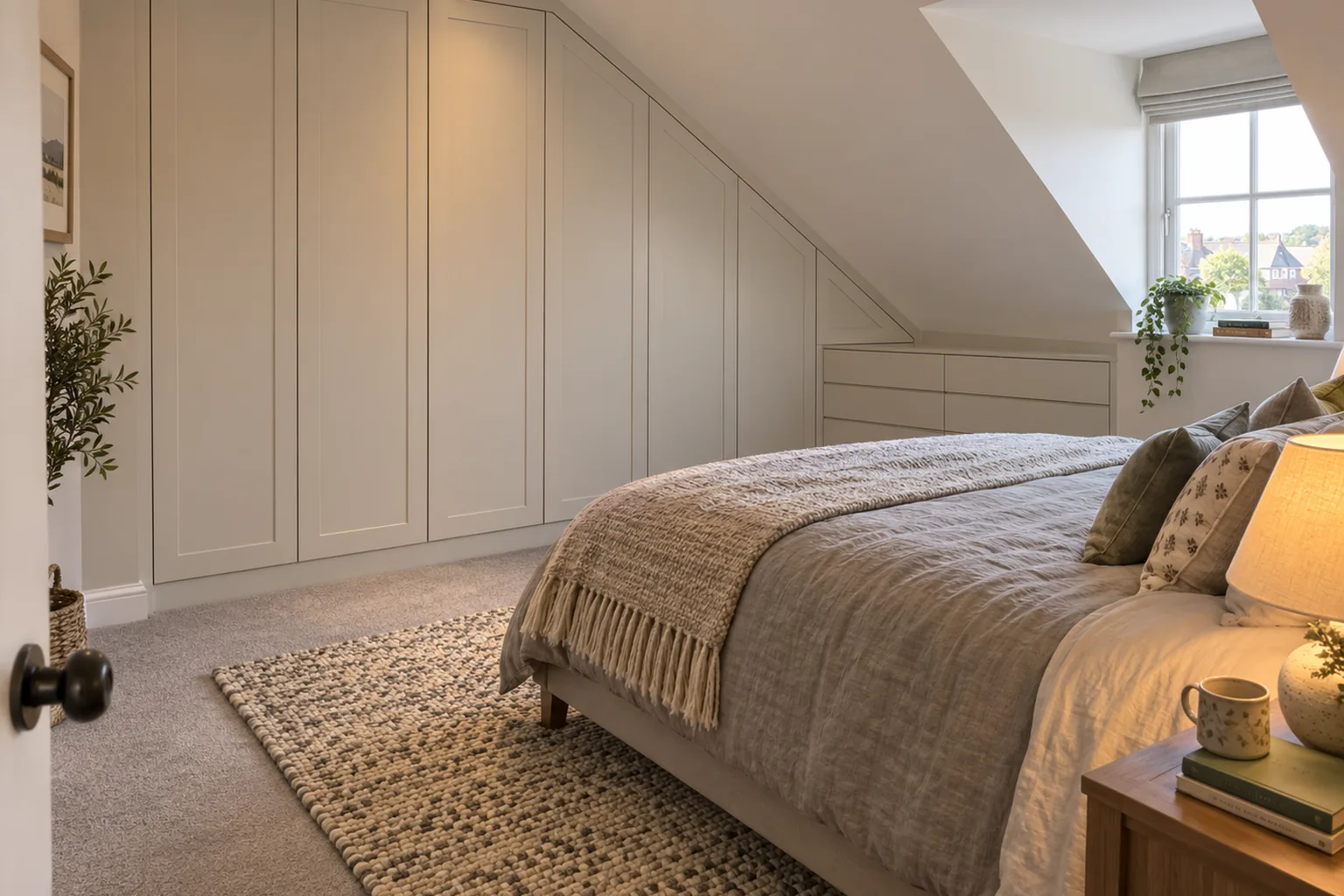
Read the guideSloping ceiling wardrobes cost £1,500–£5,999 fitted in the UK. Compare ready-made, specialist and import prices for loft and eaves runs, with worked examples.
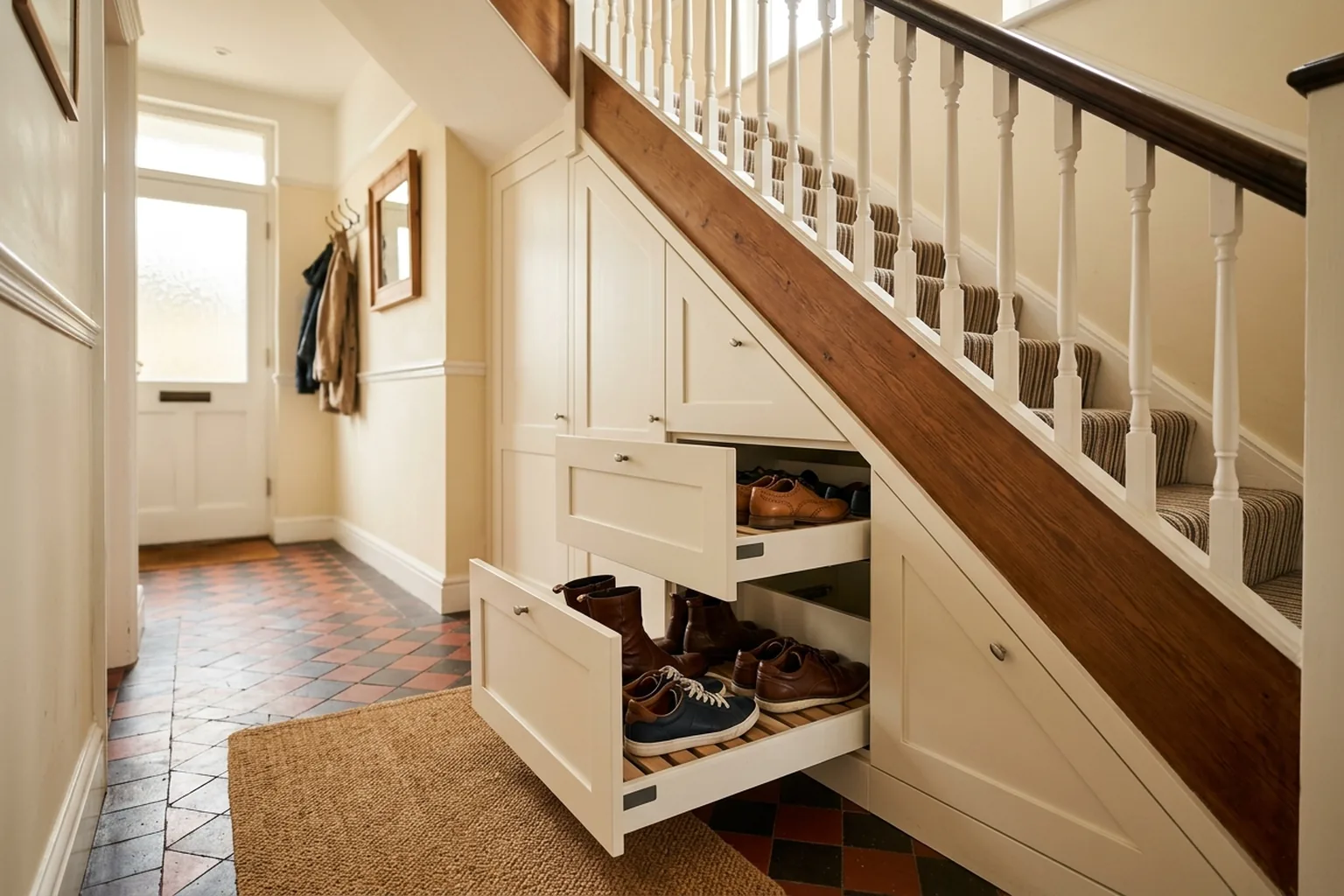
Read the guideUnder stairs storage costs £250–£8,000 in the UK. Compare specialist, joiner and import prices, worked examples, regulations and when importing pays.
Read the guideSend your drawings or a short brief — a dedicated coordinator replies with next steps and a consolidated quote.